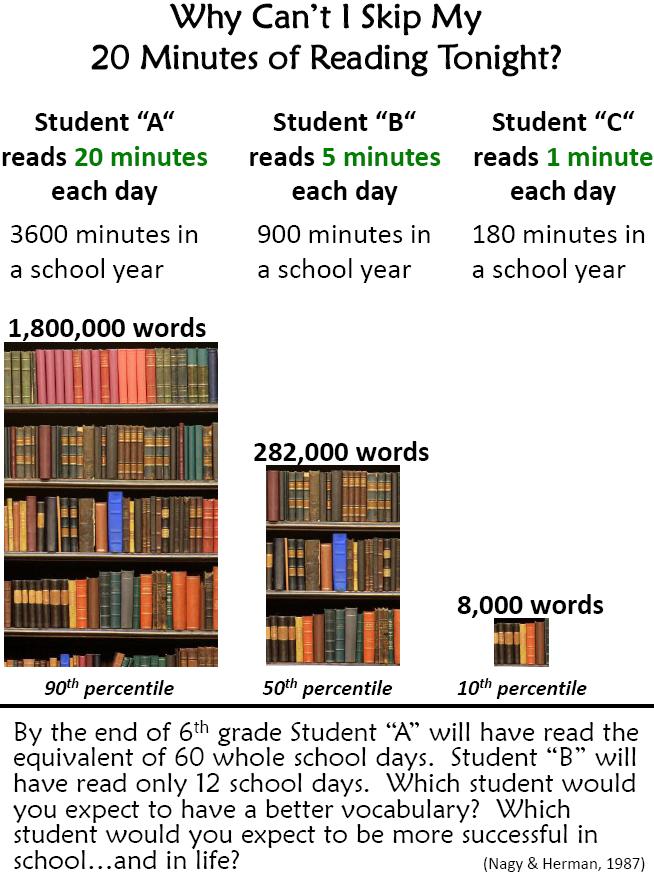
Nightly Reading Homework
The amount of free reading done outside of school has consistently been found to relate to growth in vocabulary, reading comprehension, verbal fluency, and general information (Anderson, Wilson, and Fielding 1988; Greaney 1980; Guthrie and Greaney 1991; Taylor, Frye, and Maruyama 1990). Students who read independently become better readers, score higher on achievement tests in all subject areas, and have greater content knowledge than those who do not (Krashen 1993; Cunningham and Stanovich 1991; Stanovich and Cunningham 1993). Please set aside at least 20 minutes each school night for your child to read independently or even better, aloud to you.
Math Homework
Verona utilizes the Math Expressions program for math instruction. Specifically, fourth grade’s math curriculum involves group work, hands-on activities, problem solving, logical thinking, and decision-making lessons. You can expect your child to have math homework every week. Math homework is intended to reinforce concepts learned in class. I will always explain how to do these assignments before students are sent home. Your child should not be spending more than 30 minutes on math homework. Additionally, your child (and/or you) should not experience high or excessive frustration when completing homework. If either of these situations occur, please jot me a note at the top your child's homework, and I will work with your child one-on-one in the morning to complete the work for full credit. It is important to also note that students can, and are encouraged to, bring home their math notebook to help them in completing their homework.
Unfinished & Absent Work
Any work not completed during the day will be sent home to be finished and returned the next day. If your child is absent, s/he will need to complete the work that was missed. Students will have a fair and appropriate amount of time to finish any assignment they may have missed.
Planners
Aside from this blog, planners are another way that we communicate with each other on a daily basis. At the end of each day, we will fill out planners together with brief information in each subject area so as to communicate what was learned that day.
Here are the highlights you need to know about planners:
- Homework: Homework is indicated in planners with a star.
- Clip Chart Status: Our class will use a clip chart to encourage positive behavior. This is a fluid chart; students have opportunities to move up (and down) throughout the day. Students will jot down the abbreviation indicating where they ended the day.
- Role Model: RM
- Super Star: SS
- Way to Go: WTG
- Ready to Learn: RTL (this is where students begin each day)
- Make Better Choices: MBC
- Stop and Think: SAT
- Parent Contact: PC (I will communicate with you via planner, email or phone call)
- Signatures: By signing your child's planner, you are communicating to me that s/he has read their 20 minutes of reading.
- Friday Planner Checks: While in an ideal world planners are reviewed and signed everyday, I recognize that schedules tend to be full and, at times, hectic. For these reasons, I only check planners for signatures on Fridays. Students who have 4 signatures on Fridays will be invited to participate in "Fun-day Friday".
- Notes: On occasion, I may write you a note in your child's planner. Likewise, feel free to jot down a note in your child's planner for me to read, as well. Students know to show me their planners in the morning if they have parent notes.
Homework:
- Read 20 minutes
Reminders:
- Please sign and return address/phone number confirmation sheet. This came home with students on Friday.
- Picture Day is Monday, September 25. Forms/envelopes will come home this Friday.
Supplies:
- If you have not sent in supplies yet, click here for our list.
- The most important supplies are:
- 4 composition notebooks
- 5 pads of sticky notes
- 4 folders
- dry erase markers
Thank you,
Mrs. O'Neill

No comments:
Post a Comment